

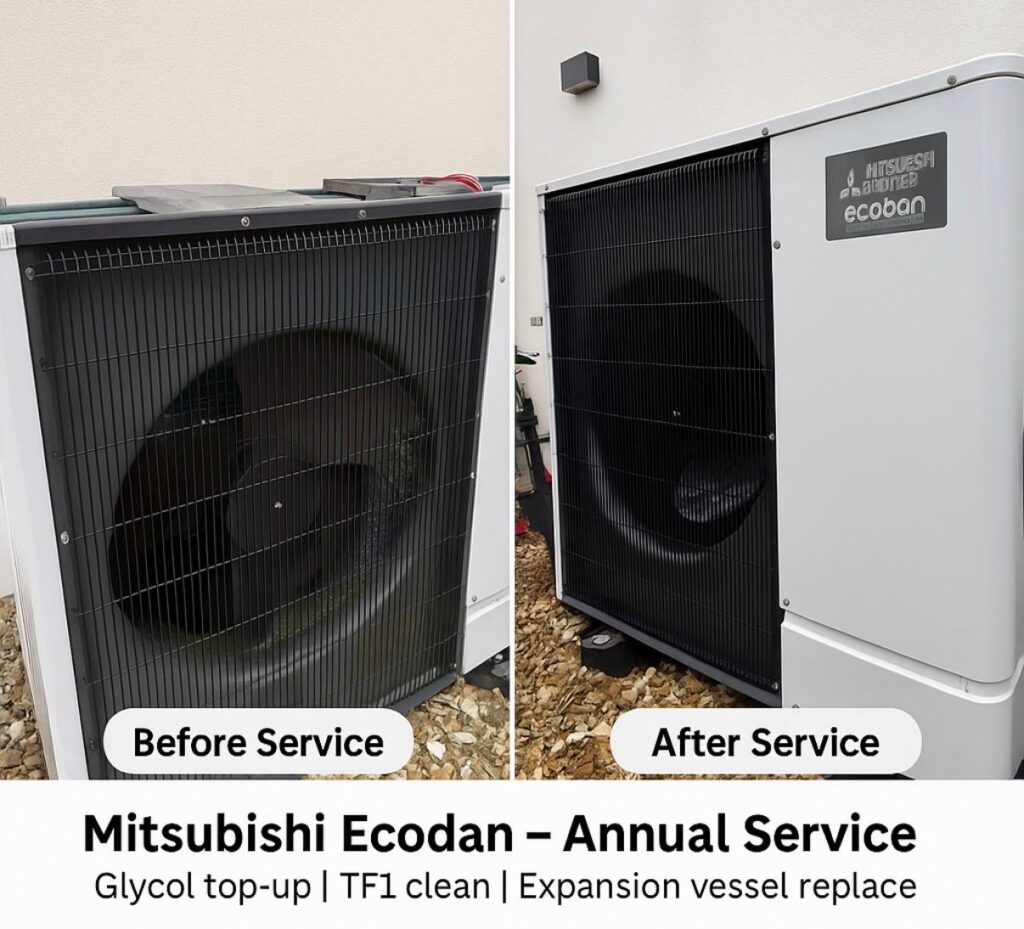
Heat Pump Servicing in Somerset: How to Save £400 a Year in Running Costs (2025 Guide)
With more homes in Somerset switching to air-source heat pumps, the question of how to keep them efficient has never been more relevant. A well-set-up system can run quietly and economically for years, but small issues can gradually push up running costs.
This guide explains how proper servicing and a few setting tweaks can save hundreds each year — without replacing a single part.
Why servicing matters more than ever
Even minor inefficiencies add up over the course of a heating season.
A slightly blocked strainer, poor flow rate, or outdated weather-compensation setting can reduce overall performance by 10–20 %, adding roughly £300–£400 per year to energy bills.
Annual servicing maintains:
- Stable SCOP values (Seasonal Coefficient of Performance)
- Extended compressor life
- Quieter, smoother operation
- Valid manufacturer warranties
Key checks during a professional service
A thorough service should cover the essentials that affect both performance and reliability:
- Glycol protection test to around –10 °C
- Expansion-vessel charge check (both heating and potable)
- Cleaning of strainers and magnetic filters
- Calibration of flow and return temperatures
- Verification of the weather-compensation curve
- Inspection of outdoor coil fins and airflow clearance
- Condensate drain check to prevent winter freeze-ups
Common issues found in 2025 services
- Crushed outdoor fins restricting airflow.
- Perished expansion-vessel membranes causing pressure swings.
- Controllers left in summer mode after warm weather.
- Missing pipe insulation on outdoor runs.
- Sludge-filled magnetic filters reducing circulation.
Most are quick fixes that restore lost efficiency immediately.
Optimising your running costs
Small adjustments can produce noticeable savings:
| Setting adjustment | Typical saving | Reason |
|---|---|---|
| Lower flow temperature from 50 → 45 °C | £100/yr | Reduces compressor load |
| Enable weather compensation (curve ~0.5) | £80/yr | Matches output to demand |
| Schedule DHW heating twice daily | £60/yr | Avoids constant reheating |
| Clean filters quarterly | £40/yr | Maintains flow rate |
| Insulate exposed pipework | £20/yr | Prevents standing losses |
Average combined saving: around £300 per year.
Recommended service frequency
- Domestic systems: once every 12 months
- Light commercial: every 6 months
- After refrigerant or electrical work: performance test recommended
Regular checks ensure sensors remain accurate, antifreeze levels stay stable, and the heating curve is seasonally adjusted.
Key takeaway
Heat pumps are designed for long life and efficiency, but they rely on clean water circuits, correct pressure, and seasonal setup.
A professional service each year — supported by good daily habits like keeping the outdoor unit clear and filters clean — can keep running costs low and comfort high all winter.
Disclaimer:
Information in this article is for general guidance only. Figures and examples are indicative and may vary by system design, property type, or manufacturer specification. Always seek professional advice before making technical adjustments.